
Key Insights
• Elevator capacity is determined by its rated load and the permitted passenger count.
• Estimated passenger count can be calculated by dividing the rated load by the assumed weight per person.
• Cabin floor area and overall elevator design also influence the approved passenger capacity.
• Different elevator applications require different load capacities based on their intended usage.
• Always consider the manufacturer’s rated specifications and applicable standards when determining the actual passenger limit.
overview
Choosing an elevator for a building involves more than deciding how it should look or where it will be installed. Its carrying capacity is equally important because it determines the maximum load the lift is designed to transport during a journey. The selected capacity should match the way the elevator is expected to be used.
But how is elevator capacity calculated? Is it based only on the combined weight of passengers, or does the size of the cabin also matter? The answer involves both rated load and usable cabin space. Understanding these measurements makes it easier to compare specifications and identify a suitable capacity for a particular application.
1. What Is Elevator Capacity?
Elevator capacity is the maximum load an elevator is designed and approved to carry during normal operation. It is usually stated in kilograms (kg) and displayed on the elevator’s rated-load plate.
There are two important terms associated with elevator capacity.
Rated Load: This represents the maximum permitted weight of passengers or goods inside the cabin.
Passenger Capacity: This is the approved number of people the elevator is designed to accommodate.
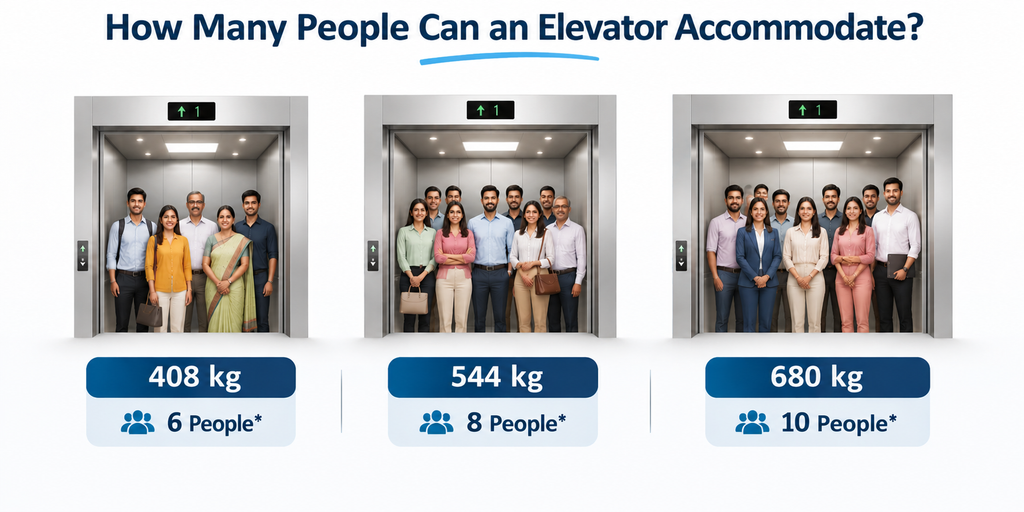
For example, a lift may be specified with a rated load of 680 kg and a passenger rating of 10 people. The actual approved rating must always be confirmed from the manufacturer’s documentation and applicable standards.
Although these two measurements are closely connected, they are not interchangeable. Rated load establishes the weight limit, while passenger capacity also considers the available cabin floor area and relevant design requirements.
2. How Is Elevator Capacity Calculated?
For a basic passenger estimate, the number of passengers can be calculated by dividing the elevator’s rated load by an assumed average passenger weight.
Elevator Capacity Calculation
Estimated Passenger Count
Example: 680 kg ÷ 68 kg = 10 passengers
This is an illustrative estimate. Actual approved passenger capacity depends on cabin area, elevator design and applicable standards.
Let’s understand this through an example.
Consider an elevator with a rated load of 680 kg. If an illustrative passenger weight of 68 kg is used, the calculation becomes:
680 ÷ 68 = 10 passengers.
Similarly, an elevator with a rated load of 544 kg would give an estimated passenger count of eight using the same assumption.
However, this calculation is only a mathematical illustration. It does not independently establish the approved passenger capacity.
The final passenger rating also depends on cabin floor area, elevator design and applicable safety standards. The manufacturer must confirm the permitted load and passenger figure for the specific elevator model.
3. Understanding Different Elevator Capacities in Kilograms
Elevators are available with different rated loads to accommodate varying passenger and transportation requirements. The following examples show how rated load relates to estimated passenger count using an assumed weight of 68 kg per person.
Elevator Load & Passenger Capacity
*Illustrative estimates based on 68 kg per person. Actual approved passenger capacity depends on cabin area, elevator design and applicable standards.
4. How Does Cabin Size Affect Elevator Capacity?
The available space inside the cabin is another important part of capacity assessment. Two elevators with similar rated loads may have different internal dimensions, which can affect how passengers and goods are accommodated.
Three measurements are particularly relevant:
Cabin Width: Determines the available horizontal space inside the elevator and influences how passengers can be accommodated.
Cabin Depth: Affects the available space for passenger movement and the arrangement of people or goods inside the cabin.
Usable Floor Area: Plays an important role in determining the permitted passenger capacity under applicable elevator design standards.
For example, a cabin intended to accommodate passengers with mobility requirements needs an appropriate layout and sufficient clear space. Similarly, a goods elevator may require room for bulky materials even when their combined weight is within the rated load.
Therefore, cabin dimensions and rated load must always be evaluated together when determining the appropriate elevator capacity.
5. What Factors Determine Elevator Capacity?
Several technical factors influence the final capacity assigned to an elevator.
1. Rated Load
The maximum weight the elevator is designed to carry is the starting point for capacity selection. It establishes the permitted load limit during normal operation.
2. Passenger Weight Assumption
An assumed average passenger weight can help estimate the number of people an elevator may accommodate. However, the final passenger rating must follow applicable design and safety requirements.
3. Cabin Dimensions
The width, depth and usable floor area influence how many passengers can be accommodated within the permitted design specifications.
4. Intended Application
A lift designed for passenger transportation may have different space and loading requirements from one intended for goods. The intended use must be considered when selecting the appropriate configuration.
5. Applicable Standards
The final rated load and passenger capacity must comply with relevant technical and safety requirements. These standards help establish the relationship between the elevator’s weight limit, cabin dimensions and approved passenger rating.
For a project-specific recommendation, consult experienced lift manufacturers in chennai and request the rated-load and approved passenger-capacity details for the exact model being considered.
6. How Does Capacity Vary by Elevator Application?
The basic principles of elevator capacity remain similar across different applications. However, the required rated load and cabin arrangement depend on what the elevator is expected to carry.
Residential Elevators
Residential elevators are generally selected based on the number of occupants, expected daily usage and available cabin space.
Homeowners should consider how many people will regularly use the lift and whether the cabin can comfortably accommodate their requirements.
When comparing options from home lift manufacturers in chennai, it is important to check both the rated load and the approved passenger capacity rather than relying on a simple weight calculation alone.
Passenger Elevators
Passenger elevators are commonly used in apartments, offices and commercial buildings. Their capacity is determined by the rated load, cabin dimensions and expected passenger requirements.
For buildings with higher passenger demand, selecting an appropriate capacity becomes particularly important. When evaluating options from passenger lift manufacturers in chennai, the published capacity should be checked against the technical documentation of the specific model.
Goods Elevators
Goods elevators are selected according to the weight and physical dimensions of the materials being transported.
For example, an elevator may have sufficient rated load to carry a particular quantity of materials, but its cabin dimensions must also provide enough space to accommodate them properly.
This is why both weight and available cabin space are considered during capacity selection.
Conclusion
Elevator capacity is determined by evaluating several factors, including rated load, passenger count, cabin dimensions and applicable design standards. Understanding how these elements work together helps identify an elevator that is suitable for its intended application.
Whether the requirement involves a residential property, commercial building or goods transportation facility, selecting the correct capacity is essential for comfortable and reliable operation.
At Steven Elevators, we provide elevator solutions for different residential, commercial and industrial requirements. Our team helps customers understand their project needs and identify suitable elevator configurations.
Looking for the right elevator for your building? Visit Steven Elevators to explore our elevator solutions and discuss your requirements.